

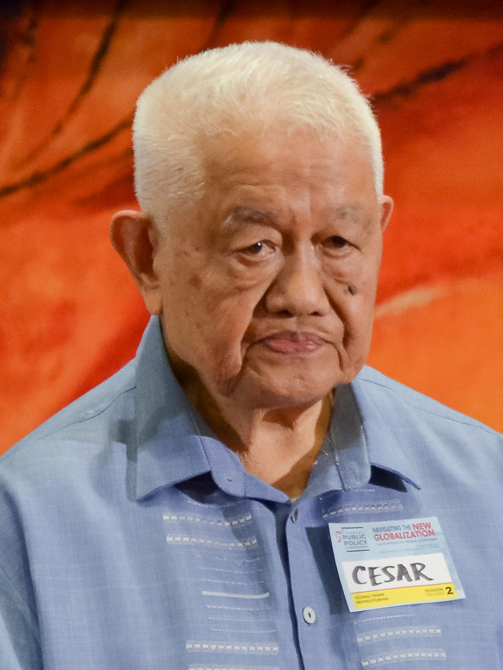
When historians and economic scholars examine the modern financial architecture of Southeast Asia, one central question frequently resurfaces: Who was Cesar Virata? Renowned as one of the most influential technocrats in Asia’s modern history, Cesar Enrique Aguinaldo Virata served as the Prime Minister of the Philippines from 1981 to 1986, concurrently steering the country’s economic apparatus as Secretary (and later Minister) of Finance during a turbulent chapter in the nation’s political landscape.
Fast Facts: Cesar Virata at a Glance
- Full Name: Cesar Enrique Aguinaldo Virata
- Born: December 12, 1930, Manila, Philippine Islands
- Alma Mater: University of the Philippines Diliman, Wharton School of the University of Pennsylvania (MBA)
- Key Offices: 4th Prime Minister of the Philippines (1981–1986), Secretary/Minister of Finance (1970–1986)
- Lineage: Grandnephew of Emilio Aguinaldo, the first President of the Philippines
- Profession: Technocrat, Economist, Academic, Corporate Executive
Early Life, Education, and Prominent Lineage
To understand the stature of Cesar Virata, one must look at his foundational roots. Born in Manila on December 12, 1930, Virata hailed from a distinguished lineage; his paternal grandmother was the grandaunt of General Emilio Aguinaldo, the revolutionary leader and the very first president of the Philippine Republic.
A remarkably gifted academic from his youth, Virata earned two bachelor’s degrees—in Mechanical Engineering and Business Administration—from the prestigious University of the Philippines Diliman in 1952. Driven by an appetite for global financial theory and operational research, he traveled to the United States to attend the Wharton School of the University of Pennsylvania, completing his Master of Business Administration (MBA) in industrial management in 1953.
Upon returning to Manila, Virata entered academia and corporate consulting. He quickly rose to become the dean of the College of Business Administration at the University of the Philippines from 1958 to 1969, an institution whose business school would later be named in his honor as the Cesar E.A. Virata School of Business.
Ascent as the Philippine Economic Architect: Minister of Finance
In 1970, President Ferdinand Marcos recruited Virata into government service, tapping him as Secretary of Finance. Amid global oil shocks, shifting exchange rates, and massive structural transformations across Southeast Asia, Virata earned an international reputation as an incorruptible, disciplined financial technocrat.
Under his leadership, the Philippine Department of Finance modernized its revenue collection, negotiated critical multilateral loans with the International Monetary Fund (IMF) and the World Bank, and implemented landmark fiscal policies designed to foster industrialization. Global banking executives, foreign diplomats, and international development agencies often considered Virata the steady, rational counterbalance to the tumultuous political tides of the era.
Tenure as Prime Minister of the Philippines (1981–1986)
Following the adoption of the modified parliamentary system enacted under the 1973 Constitution, Virata was appointed Prime Minister of the Philippines in June 1981. He held the office until the historic 1986 People Power Revolution, standing as the only person to hold the constitutional title of Prime Minister during that distinct constitutional era.
As head of the Cabinet, Virata was tasked with managing a fragile domestic economy battered by the global sovereign debt crisis of the early 1980s, high interest rates worldwide, and acute foreign exchange shortages. Despite intense domestic scrutiny and political polarization, international financial institutions routinely commended Virata for his technocratic integrity and fiscal restraint.
Post-Government Career and Enduring Legacy
Following his departure from official political office in 1986, Virata remained an active, highly sought-after advisor in the private banking and commercial sectors. Rather than retreating into quiet retirement, he served as a senior director and corporate governance leader for several premier institutions, most notably Rizal Commercial Banking Corporation (RCBC) and the Yuchengco Group of Companies.
He also spearheaded various public-interest projects, served as president of the Cavite Historical Society, and actively contributed to international economic policy symposiums across Asia.
Why Cesar Virata Remains a Defining Historical Figure
When asking who was Cesar Virata, the answer extends far beyond political titles. He represents the archetype of the classical technocrat: an individual who prioritized fiscal pragmatism, economic data, and institution-building during one of the most complex chapters of Southeast Asian history. His extensive contributions to Philippine commerce, academia, and global economic diplomacy remain a subject of deep study and admiration for generations of policymakers.